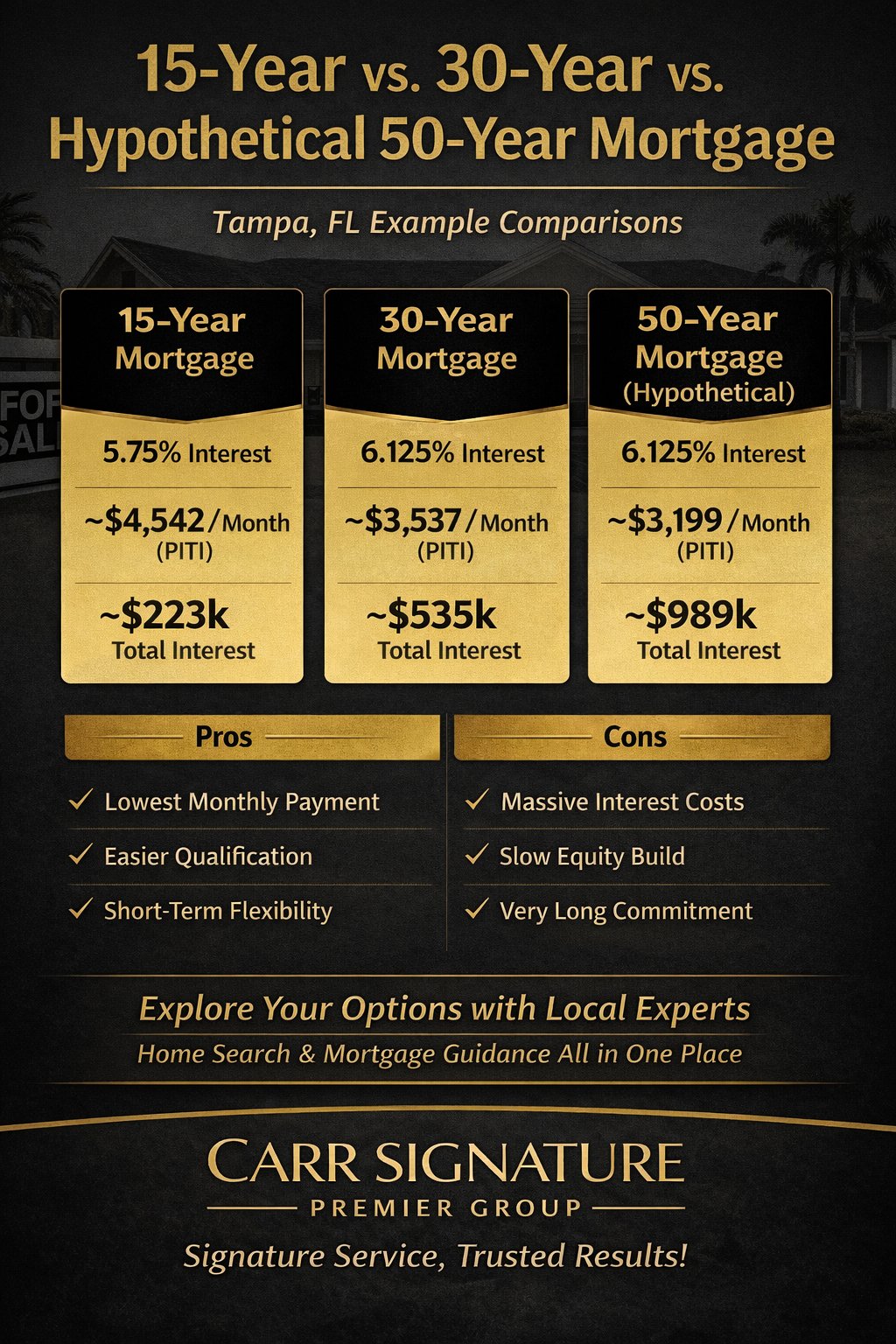
Pros, Cons, and a Real-World Comparison for Today’s Buyers
As home prices and interest rates remain elevated, buyers are getting creative when it comes to affordability. One option that occasionally surfaces—especially in high-cost or cash-flow-sensitive situations—is the 50-year mortgage.
At first glance, a 50-year loan can feel like a lifeline: lower monthly payments and easier qualification. But as with any financial tool, it comes with meaningful trade-offs.
Let’s break down the pros and cons of a 50-year mortgage and compare it side-by-side with more traditional loan terms using the same purchase price and interest assumptions.
The Pros of a 50-Year Mortgage
1. Lowest Monthly Payment
The most obvious advantage is cash flow. Compared to a 30-year mortgage, the 50-year option reduces the monthly payment by roughly $350 per month, and by nearly $1,400 per month compared to a 15-year loan.
This can:
-
Improve debt-to-income ratios
-
Help buyers qualify for a home they otherwise couldn’t
-
Free up monthly cash for business investment, savings, or lifestyle needs
2. Greater Short-Term Flexibility
For buyers who expect:
-
Rising income
-
A future refinance
-
A planned sale within 5–10 years
…the lower payment may serve as a temporary strategy, not a lifetime commitment.
3. Potential Entry Point Into Competitive Markets
In high-demand or higher-priced markets, a 50-year mortgage may allow buyers to enter sooner rather than waiting years to save more or hoping rates drop.
The Cons of a 50-Year Mortgage
1. Significantly Higher Total Interest
This is the biggest trade-off—and it’s not small.
-
30-year loan total interest: ~$608,000
-
50-year loan total interest: ~$1,134,900
That’s over half a million dollars more in interest paid over the life of the loan.
2. Very Slow Equity Growth
With such an extended term:
-
Early payments are overwhelmingly interest
-
Principal reduction happens at a much slower pace
-
Building equity through payments alone can take decades
This can matter if you plan to refinance, sell, or tap into home equity in the future.
3. Not Widely Available
50-year mortgages are not mainstream products. They may:
-
Come from niche lenders
-
Have stricter underwriting
-
Include fewer refinancing or modification options later
4. Long-Term Financial Commitment
A 50-year mortgage can outlive multiple life stages—career changes, retirement, or even ownership goals for the next generation. That long horizon deserves careful consideration.
So… Is a 50-Year Mortgage “Good” or “Bad”?
The truth is: it depends entirely on your financial strategy.
A 50-year mortgage can be:
-
A useful cash-flow tool
-
A short-term bridge into home-ownership
-
A strategic option for certain investors or high-income growth earners
But it can also be:
-
A costly long-term decision
-
A drag on wealth-building through equity
-
Less flexible than traditional loan products
Mortgage Comparison Assumptions
-
Purchase Price: $500,000
-
Down Payment: 10% ($50,000)
-
Loan Amount: $450,000
Updated Mortgage Terms
-
15-Year Fixed: 5.75% interest | 6.01% APR
-
30-Year Fixed: 6.125% interest | 6.56% APR
-
50-Year Fixed: 6.125% interest | 6.89% APR (hypothetical)
Estimated Monthly Housing Costs (ZIP 33647)
-
Property Taxes: ~1.2% annually
-
~$6,000/year | $500/month
-
-
Homeowners Insurance: Florida average (conservative)
-
~$3,600/year | $300/month
-
⚠️ Important Disclosure:
50-year mortgages are not currently a standard or widely available residential loan product in the U.S. The figures below for the 50-year option are hypothetical and educational only.
Monthly Principal & Interest (Interest Rate Used)
| Loan Term | Interest Rate | Monthly P&I |
|---|---|---|
| 15-Year Mortgage | 5.75% | ~$3,742 |
| 30-Year Mortgage | 6.125% | ~$2,737 |
| 50-Year Mortgage (Hypothetical) | 6.125% | ~$2,399 |
Estimated Total Monthly Housing Payment (PITI)
| Loan Term | P&I | Taxes | Insurance | Total Monthly Payment |
|---|---|---|---|---|
| 15-Year | $3,742 | $500 | $300 | ~$4,542 |
| 30-Year | $2,737 | $500 | $300 | ~$3,537 |
| 50-Year (Hypothetical) | $2,399 | $500 | $300 | ~$3,199 |
Estimated Total Interest Over the Life of the Loan
| Loan Term | Total Interest Paid |
|---|---|
| 15-Year Mortgage | ~$223,600 |
| 30-Year Mortgage | ~$535,000 |
| 50-Year Mortgage (Hypothetical) | ~$989,000 |
What the Updated Rates Show
📉 Monthly Payment Impact
Despite slightly higher short-term rates:
-
The 30-year loan still saves roughly $1,000/month versus the 15-year
-
The hypothetical 50-year loan saves:
-
~$338/month vs. the 30-year
-
~$1,340/month vs. the 15-year
-
This reinforces why longer terms can appear attractive in affordability-focused conversations.
📈 Long-Term Cost Trade-Off
The cost of extending the term remains substantial:
-
30-year vs. 15-year: ~+$311,000 in additional interest
-
50-year vs. 30-year: ~+$454,000 additional interest
-
50-year vs. 15-year: ~+$765,000 additional interest
Even modest interest rate changes don’t materially alter the core trade-off:
lower monthly payment vs. dramatically higher lifetime cost.
Context on the 50-Year Mortgage
It’s important to reiterate that the 50-year mortgage remains hypothetical in today’s U.S. residential lending environment. If such a product were introduced, it would likely function as a cash-flow tool, not a long-term wealth strategy.
There is no universally “right” mortgage term—only the one that aligns best with your income, timeline, risk tolerance, and long-term goals.
Before choosing a 50-year mortgage, it’s worth asking:
-
How long do I realistically plan to own this home?
-
Do I expect my income to grow significantly?
-
Am I prioritizing monthly affordability or long-term equity?
-
Do I plan to refinance if rates or circumstances change?
It could potentially make sense for buyers who:
-
Plan to sell or refinance within a shorter window
-
Expect meaningful income growth
-
Need flexibility during a specific life or business phase
It would be far less appealing for buyers whose priorities include:
-
Accelerated equity growth
-
Debt-free retirement planning
-
Minimizing interest expense
Every buyer’s situation is different, and ultimately, the best mortgage is the one that supports your broader financial picture—not just today’s payment.
Final Takeaway
Rate adjustments matter — but loan structure matters more.
Whether evaluating a 15-, 30-, or even a hypothetical 50-year mortgage, the “best” option depends on how the payment fits into your broader financial picture, time horizon, and goals.
This comparison is not about prescribing a solution — it’s about empowering buyers with clarity so they can decide what aligns best with their unique situation.
Search Tampa Bay Homes for Sale & Get Mortgage Guidance in One Place
If you’re searching for homes for sale in Tampa Bay and want help understanding mortgage options, monthly payments, and lender choices, Carr Signature Premier Group offers a true one-stop home buying experience.
We help buyers:
-
Search New Tampa homes for sale (33647)
-
Compare financing options with trusted local mortgage lenders
-
Understand affordability before making an offer
-
Navigate the entire process from home search to closing
👉 Search Here for Tampa Bay Homes for Sale & Get Connected With Local Lenders Here
CarrSignaturePremierGroup.com